

Why small businesses struggle with AI (and how to fix it)
Learn why AI feels overwhelming, what the research really shows, and how small business owners can start using AI in practical ways.
12/19/20254 min read


Overview
Many small business owners struggle with AI not because they’re opposed to it, but because most advice doesn’t translate into real, everyday workflows. Much of the information available is either too technical, too strategic, or aimed at much larger organisations. Research shows that hesitation around AI is usually a clarity issue, not a capability one. The most effective way for small businesses to use AI is to start small, focus on practical tasks, and experiment in low-risk ways. When approached this way, AI becomes a useful support tool rather than an overwhelming initiative.
When you dig into the data, something interesting pops up: small business owners aren't saying no to AI. They're saying, "I don't know where this fits."
More than half of business leaders admit they don't really understand how AI applies to what they do. A third haven't found a use case that makes sense. According to a 2025 SBA Office of Advocacy analysis, nearly 82 % of businesses with fewer than five employees reported that AI wasn’t applicable to their operations, citing this as a key reason they’re not planning to adopt it. Small business owners are frequently consumed by immediate, day-to-day operations.
While AI is often promoted as a "productivity tool," many small businesses think about its uses differently and remain unclear on the practical, affordable ways it can enhance their specific model. For example, 34% of "Explorers" (those researching but not yet using AI) stay on the sidelines because they do not see a clear path to return on investment (ROI) or a compelling use case for their niche.
That's a massive clarity problem.
In South Africa, there's also hesitation around high implementation costs and privacy compliance. In the US, it's death by options - too many tools, too much hype, not enough "here's how this actually helps your day-to-day grind." Same outcome either way: smart, capable people sitting on the sidelines because they may be missing a decent starting point.
I get it. Every second article on the interweb is screaming about how AI is taking over the world, and if you don’t use it, you’ll be left behind. Meanwhile, you're sitting there thinking: "That’s great, but what does that actually mean for me?"
You've got a business to run. Clients to chase. A team that needs you. The last thing you need is another rabbit hole that eats three hours and leaves you more confused than when you started.
Here’s the thing about that stuck feeling: you’re not alone. There’s plenty of AI content out there, but almost none of it answers the question you’re actually asking. “What does this do for my business, on a normal Tuesday?” That disconnect is what’s keeping a lot of smart owners frozen. The research backs this up.
What the research shows
So what's really going on?
Honestly, a lot of AI marketing is designed for large organisations with innovation budgets, or for people who genuinely enjoy experimenting with new tools in their spare time. If that’s not your reality, the advice doesn’t feel useful, and it doesn’t stick.
AI ends up sounding like a big strategic project. Something you need consultants for. Something with a “digital transformation roadmap” that somehow explains very little.
In South Africa, that hesitation is often amplified by a healthy scepticism around AI, particularly when it comes to data security, scams, and trusting automated systems with real customer information. Meanwhile, the practical wins, like automating invoices, nudging clients to pay on time, or quietly warming up leads in the background, get lost in the noise.
It’s like signing up for a gym and being given a 40-page training plan before anyone shows you how to use the treadmill. You don’t feel motivated. You feel tired already.
What actually works
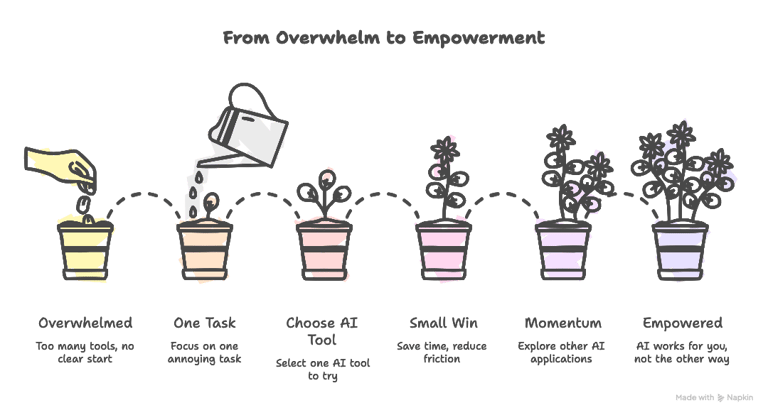
1. Forget strategy. Start with annoyance.
Seriously. What frustrated you this week? What task made you think "I can't believe I'm still doing this manually"? That's your entry point. Just one thing that's eating your time.
Maybe it's rewriting the same proposal intro for the hundredth time. Maybe it's trying to summarise a 40-page document. Maybe it's staring at a blank screen, trying to write a job ad.
Pick that. Try an AI tool on it. See what happens.
2. Make it low-stakes
You're not "implementing AI." You're just... testing something. There's no contract. No commitment. No one's watching. Grab a free tool. Give it 20 minutes. If it helps, great, keep using it. If it doesn't, you've lost nothing but a coffee break.
The people actually getting somewhere with this aren't the ones with the best strategy. They're the ones who tried something small, noticed it worked, and thought, "Huh, what else could this do?"
3. Get the order right
Here's where people trip up: they hear about AI for customer service, marketing, sales, HR, operations and try to figure out all of it at once. Don't do that.
Start with your own productivity. Use AI to help you work faster - writing, research, and admin. Get comfortable with it. Then move to internal stuff: documentation, onboarding materials, reports. Then think about customer-facing applications.
This way, by the time you're putting AI in front of clients, you actually know what you're doing. No one wants to be the business whose chatbot confidently tells customers complete nonsense.
Where to from here?
OnBizPresence helps small businesses like yours get found, get chosen, and get booked. From Google Business Profile (GBP) optimization and local SEO to website development, review strategy, and smart automation, we handle the digital foundations so you can focus on your clients. We create a visible, credible online presence that works quietly in the background, turning searches into sales.
If you've been circling this for months, you're not behind. You just haven't found your starting point yet.If you’d like a practical starting point, this
👉 AI Small Win tool walks you through a few quick questions and suggests one simple way to test AI in your business with no commitment or overwhelm.
Phone / whatsapp
+27 73 431 9787
Copyright © 2025 Onbizpresence. All rights reserved.
social media
+27 82 261 5617